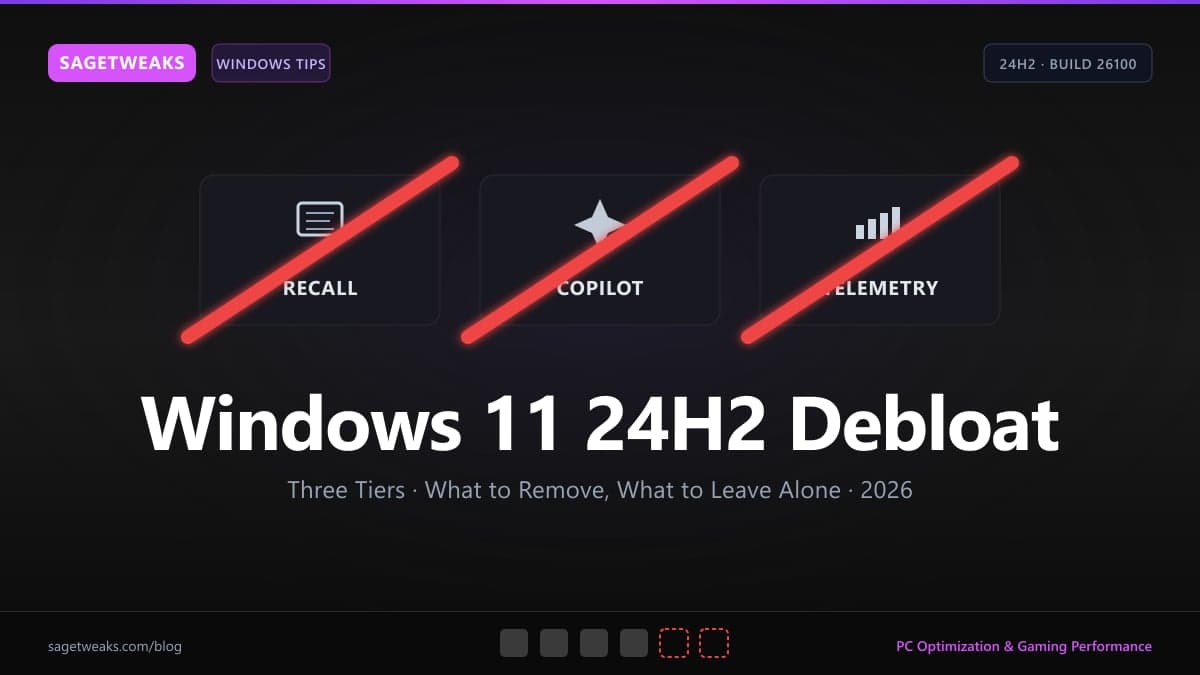
Windows 11 24H2 Debloat Guide — What to Remove, What to Leave Alone
Windows 11 24H2 (Build 26100) added a meaningful pile of new bloat — Recall, Copilot+ AI Explorer, expanded telemetry, and a quiet reset of taskbar defaults during the upgrade. If you debloated on 23H2 and just upgraded, your old script doesn't catch the new surfaces.
This is the 24H2-specific debloat plan: what's new to remove, the three-tier strategy that actually works, and what to leave alone unless you want to reinstall Windows.
Tested on Windows 11 24H2 (Build 26100). Last verified May 2026.
What 24H2 Added That Needs Cleaning
24H2 is the largest platform change since Windows 11 launched. The bloat additions you should plan to remove:
- Recall (Copilot+ PCs primarily, expanding) — periodic AI screenshots indexed for search. Privacy + disk + CPU cost.
- AI Explorer / Click to Do — always-on context-menu AI actions over images and text.
- Copilot taskbar pin — re-pinned by default in 24H2 even if you removed it on 23H2. Full removal in our Copilot removal guide.
- Expanded telemetry — diagnostic data sliders silently reset to "Optional" defaults during the 24H2 upgrade.
- Re-pinned Microsoft 365 / Edge / OneDrive taskbar entries.
- Game DVR re-enabled for many users — was off on 23H2, came back during the upgrade.
- Bundled AppX bloat — full removal pattern in our Windows 11 bloatware guide.
The Three-Tier Approach
Debloating Windows 11 24H2 fits a clean three-tier model. Pick the tier that matches your starting point and how much friction you'll accept:
- Tier 1 — Already on 24H2, want to clean what's there now
- Tier 2 — Want repeatable cleanup across multiple PCs
- Tier 3 — Doing a fresh install, want to ship a clean image from day one
Going from tier 1 → 3 increases up-front effort and decreases ongoing maintenance.
Tier 1 — Settings-Level Cleanup (~10 minutes)
If you're already on 24H2, start here. Everything is in the Settings app — no scripts, no risk.
- Recall — Settings → Privacy & security → Recall & snapshots → toggle off "Save snapshots" and clear existing snapshots
- Copilot taskbar pin — Settings → Personalization → Taskbar → toggle Copilot off (registry method in the Copilot removal guide for full removal)
- Telemetry slider — Settings → Privacy & security → Diagnostics & feedback → set to "Required diagnostic data only" + toggle off everything below. Full privacy hardening pass: Windows 11 privacy settings for gaming.
- Activity history — Settings → Privacy & security → Activity history → uncheck "Store my activity history" + Clear
- Game DVR — Settings → Gaming → Captures → toggle off "Record what happened"
- Background app permissions — for individual apps: Settings → Apps → Installed apps → Advanced options → Background apps permissions → "Never"
This handles ~80% of the user-facing bloat. For deeper system-level cleanup (services, scheduled tasks), keep going to Tier 2 — and see disable Windows 11 services for gaming for the service-level surface.
Tier 2 — Script-Based Debloat (~5 minutes)
For repeatable cleanup or deeper coverage, script-based debloating handles 50+ tweaks in one pass. Two open-source tools worth knowing about — both safe, both create restore points before any change:
Win11Debloat (Raphire) — single PowerShell script with checkbox UI. Best for: minimum-friction 24H2 cleanup with one run. Toggle the categories ("Disable Telemetry", "Remove Copilot", "Debloat AppX") and execute. About 30 seconds.
ChrisTitusTech WinUtil — broader Windows utility with tabs for app installs, tweaks, config, and updates. Best for: power users keeping the tool around for ongoing maintenance. Tweaks panel covers the Win11Debloat surface plus more, plus Microwin (Tier 3 ISO generation).
When to pick which: Win11Debloat if you want a one-shot cleanup and are done. WinUtil if you'll keep the tool for ongoing setup, troubleshooting, and Winget app management.
Both adapt their removal logic when Microsoft changes the surface — they update faster than blog posts. Star both repos and pull the latest before each major Windows feature update.
Tier 3 — Custom ISO with NTLite or Rufus (~30–60 minutes)
For a fresh install or a clean reinstall, the cleanest path is to debloat the ISO before installation — the bloat never gets installed at all.
Rufus — easiest entry point. Latest builds include "Quality of Life" toggles during USB creation: skip OOBE Microsoft account requirement, remove preinstalled apps, disable Recall, skip BitLocker auto-encrypt. Five clicks during Rufus USB build.
NTLite — power-user ISO surgery. Remove Windows components (Cortana, Edge, Print Spooler if you don't print), integrate drivers and updates, set defaults, build a fully unattended install. Free for non-commercial use.
Microwin (inside ChrisTitusTech WinUtil) — takes an official 24H2 ISO and produces a debloated version, removing AI features, telemetry, and pre-installed apps while maintaining update compatibility.
For a gaming PC you'll keep 2+ years, this tier pays off. Ongoing maintenance is near zero — the bloat is never installed in the first place.
The "Absolutely Don't Touch" List
Some surfaces look like bloat but break the OS if removed. Don't experiment with these:
- Microsoft Defender / Windows Security — even if you run third-party AV, Defender provides Secure Boot integration
- Microsoft Edge — used as a rendering engine by other Windows features (PDF preview, Outlook web links)
- Visual C++ Runtimes (2015–2022 Redistributables) — required by most games and applications
- DirectX Runtime — every game needs this
- .NET Framework / .NET Runtime — critical for many apps
- Microsoft Store — needed to reinstall apps you've removed and to receive inbox app updates
If a debloat script's "extreme" preset offers to remove any of these, decline. The marginal RAM savings aren't worth a broken install.
24H2-Specific Gotchas
Three things changed in 24H2 that affect any debloat work:
1. HVCI is now default-on — Hypervisor-protected Code Integrity. Adds roughly 5–15% gaming overhead in CPU-bound titles (varies by workload — competitive shooters and CPU-heavy sims see the larger end of the range; GPU-bound AAA titles see less). Settings → Privacy & security → Windows Security → Device security → Core isolation → Memory integrity → Off. Covered in depth in our 24H2 gaming optimization guide.
2. VBS (Virtualization-Based Security) — separate from HVCI but related, default-on for Copilot+ PCs. Same performance impact, separate toggle. Check status with msinfo32; disable via Group Policy or bcdedit.
3. Game Bar / Game DVR re-enabled — many users had this off on 23H2. The 24H2 upgrade flipped them back to default. Re-disable: Settings → Gaming → Game Bar (off) and Captures (off).
Performance Verification After Debloating
After any debloat work, verify the gains are real with measured numbers:
- Idle CPU — Task Manager → Performance → CPU. Should sit at 0–3% with nothing running. Pre-debloat 24H2 typically idles 5–10%.
- Idle RAM — same tab. Aim for under 3GB on a fresh boot.
- Boot time —
Powercfg /sleepstudyfor the breakdown. Sub-30s SSD boots are normal post-debloat. - Background process count — Task Manager → Processes. Drop from 100+ to 60–75.
- FPS test — same game, same scene, before/after. Use CapFrameX for accurate 1% lows comparison.
If the numbers haven't improved, the debloat didn't take — re-run the script. For ongoing per-process priority management beyond debloating, see our SageTweaks vs Process Lasso comparison.
The Maintenance Loop — What Comes Back After Patch Tuesday
Microsoft re-stages some surfaces during cumulative updates. After every Patch Tuesday and especially after feature updates:
- Confirm Recall, Copilot, and Game DVR settings are still off
- Re-check telemetry slider position — it sometimes resets
- Scan the taskbar for newly-pinned items (re-pinning is a common silent change)
- If anything reverted, re-run the script from Tier 2
This 30-second monthly check prevents slow drift back to a bloated install. WinUtil and Win11Debloat both adapt to new Microsoft surfaces — pull the latest before running.
FAQ
Will debloating break Windows updates? No. Defender, Windows Update, and core security run independently. Don't remove those, don't worry about the rest.
Is Recall safe to leave on? For most users, no — disk + CPU + privacy cost without a clear use case. The encryption is solid but the data scope is broad. Off by default unless you specifically want it.
Should I do all three tiers? No. Pick one. Tier 1 for current installs, Tier 2 if you'll repeat across machines, Tier 3 only for fresh installs.
Does debloating violate the Windows EULA? No. Modifying user-accessible settings and removing optional apps is explicitly allowed. ISO modification (Tier 3) for personal use is also fine. Commercial redistribution of modified ISOs is the only restricted case.
Pick the tier that matches your starting point and ship it once. For a fully tuned Windows 11 24H2 install where debloating is paired with deeper system, registry, and gaming-specific tuning, SageTweaks automates the whole stack and adapts as Microsoft moves things around between feature updates.
Written and benchmarked by the SageTweaks editorial team. Guides are tested on real Windows gaming hardware and re-validated after major Windows and GPU driver updates.
More from SageTweaks →SageTweaks
Ready to review guided PC optimization?
Use SageTweaks to review FPS, input latency, and Windows overhead workflows. Guided optimization for Windows 10 & 11.
- Guided GPU, CPU & power plan workflows
- Dedicated and detected-game FPS profiles
- Registry cleaner & startup manager
- Monthly, Yearly & Lifetime plans
30-day money-back guarantee
Next steps
Free PC optimization checklist
The 47-tweak manual version — yours to keep.
Free per-game FPS cheat sheets
Printable settings for Valorant, CS2, Fortnite, Apex.
See every SageTweaks feature
System tweaks, game profiles, cleaner, registry, power plans.
How we keep your PC safe
VirusTotal report published, rollback support, clear network use.
Read user reviews
Read public feedback and product notes before you buy.
Compare plans
Monthly $5.99 · Yearly $49.99 · Lifetime $79.99.
Related Posts
Windows 11 Privacy vs Performance: What You Actually Lose by Disabling Features
Every Windows 11 privacy toggle has a performance cost. We explain what you actually give up disabling VBS, telemetry, and Copilot — and how to decide.
Windows 11 25H2 Gaming Optimization: What's New & How to Tune
Windows 11 25H2 brings real gaming gains and one known-game-breaking bug. Here's how to update safely and what to tune for the highest FPS.
Does VBS Hurt Gaming Performance? How to Disable It Safely
VBS gaming performance complaints are real — Virtualization-Based Security adds CPU overhead that can cost FPS. Here's how to check if VBS is on and disable it safely.